Fire safety guide
Who is the responsible person for fire safety?
The fire safety responsible person in Reigate is whoever controls the premises. This might be a landlord letting flats, an employer running an office on Bell Street, or a managing agent acting for the freeholder. Find out where the duty sits and what to arrange first.
Defining the responsible person under the law
The phrase who is the responsible person comes up constantly in fire risk management because it determines who faces prosecution if something goes wrong. Under the Regulatory Reform (Fire Safety) Order 2005, the responsible person is whoever controls the premises. For a workplace, that is the employer. For rented accommodation, it is usually the landlord or the managing agent, depending on the lease.
A fire safety responsible person in Reigate might run a shop on the High Street or let out rooms in a Victorian terrace. The title does not change with the size of the building. If you have control, you carry the employer fire safety obligations UK law sets out, or the equivalent landlord fire safety legal duties. Those duties mean you must arrange a suitable fire risk assessment, keep escape routes clear, maintain detection equipment and make sure anyone using the building knows how to get out safely. You can read more about arranging one through the guidance on [how to set up an assessment](/who-needs-what/arranging-an-assessment).
Flats above shops and mixed-use buildings
Mixed-use buildings cause confusion. If you let out two flats above a shop in Reigate, you are likely the responsible person for the residential parts and any communal areas such as stairwells and hallways. The shop tenant or owner usually holds responsibility for their own commercial unit. But the structure separating them, the floors, walls and service risers, often falls to the freeholder.
This means several parties might hold a shared building fire duty over different sections of the same address. Each party must assess the areas they control and cooperate with the others so there are no gaps. A specialist firm will look at where one area ends and another begins. They check fire doors, compartmentation and alarm links between the zones. More detail on how these buildings work is available in the notes on [flats above shops](/who-needs-what/flats-above-shops).
Managing agents and freeholder obligations
Using a managing agent does not automatically move the legal duty away from you as a freeholder. The agent takes on managing agent fire risk responsibility only if the contract explicitly delegates those tasks to them. Even then, the freeholder retains ultimate accountability under the law.
If the agent fails to commission a fire risk assessment or ignores maintenance issues, enforcement officers will still look at the freeholder. Clear written agreements stating exactly who arranges fire risk assessment work, who tests alarms and who inspects fire doors prevent disputes later. Both parties should know their roles before a problem arises. Where an HMO is involved, the duties tighten further. Landlords operating shared housing should review the specific requirements for [HMO assessments](/checks-and-training/hmo-fire-risk-assessment-reigate).
Employers running small offices and shops
As an employer with a small office on Bell Street, your obligations cover everyone who works there and anyone who visits. You must ensure a fire risk assessment is completed by a competent person, that staff receive fire safety awareness training, and that emergency routes remain unobstructed at all times.
For very small premises with few employees, the steps might seem straightforward, but the paperwork still needs to exist. You need a record of the assessment, evidence of staff training, and a log showing that alarms and extinguishers are checked regularly. A nominated person within the business often handles the day-to-day checks, while a specialist firm carries out the formal assessment. Employers can find out what a [nominated person](/checks-and-training/nominated-person-service-reigate) actually does to support this process.
Shared control and multiple duty holders
When more than one party has control of a building, the duty is shared. Each responsible person must manage the risks in the areas they control and coordinate with the others. In a block of flats in Reigate, the freeholder might manage the external walls and roof, a managing agent handles the internal corridors, and individual leaseholders are responsible inside their own homes.
The law requires these parties to communicate. If one person changes a fire door or blocks a corridor, the others need to know because it affects the whole escape route. Failure to cooperate is itself a breach of the regulations. Specialist firms carrying out [compartmentation surveys](/checks-and-training/compartmentation-survey-reigate) often find issues that cross boundaries between different responsible persons, making cooperation essential rather than optional.
Enforcement visits and missing records
If the fire service visits a premises in Reigate and no one can show who is responsible, or if there is no current fire risk assessment, the consequences begin immediately. Inspectors can issue an enforcement notice requiring specific work within a set timeframe. In serious cases, they can prohibit the use of part or all of the building until the risks are addressed.
Prosecution follows where there is a clear failure to comply. Fines are unlimited, and imprisonment is possible for severe breaches. The absence of paperwork does not remove the duty; it simply proves the duty was ignored. Keeping records of who arranges fire risk assessment work, when it was done, and what actions followed is the basic proof of compliance. Guidance on responding to a [council fire safety letter](/who-needs-what/council-fire-safety-letter) explains what happens when local authorities start asking questions.
What to arrange once you know your role
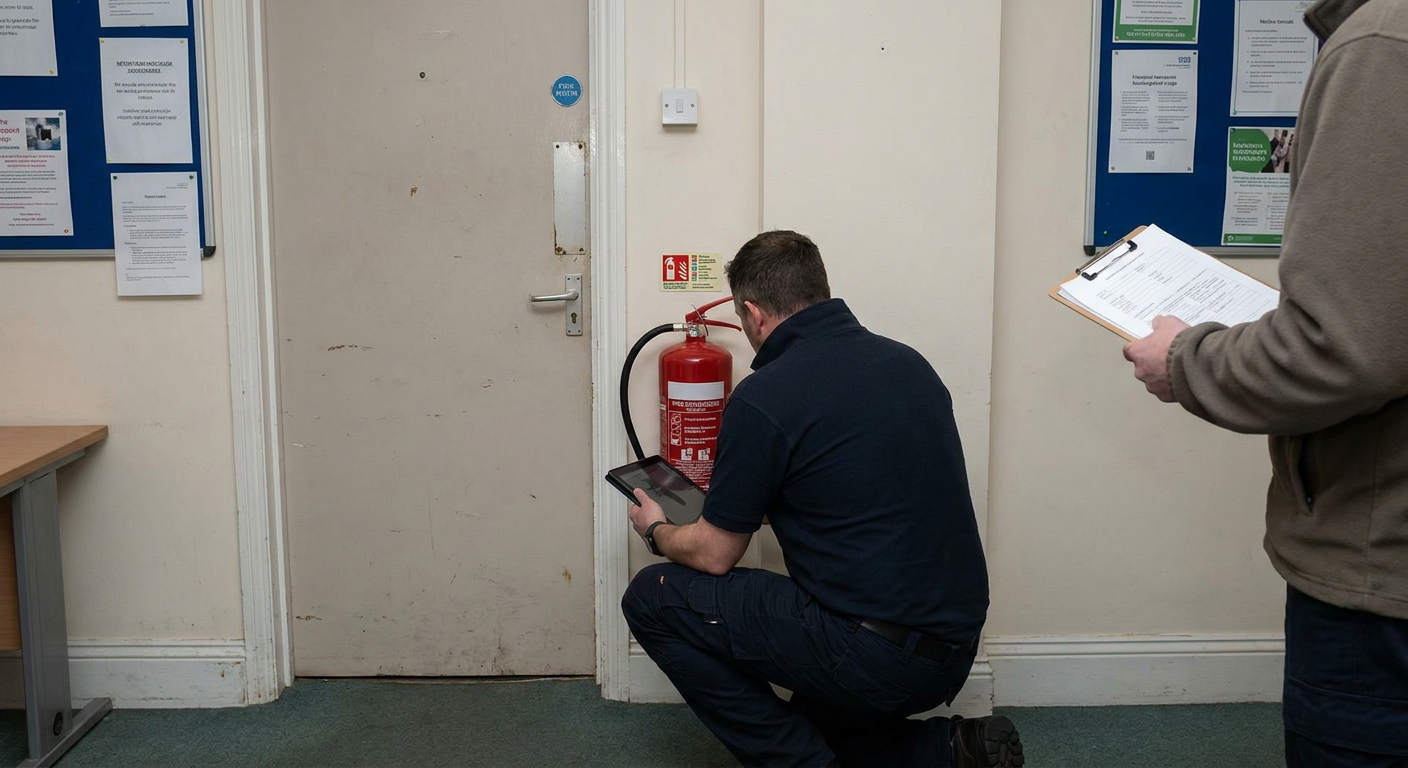
Once you know you are the responsible person, the first thing to arrange is a fire risk assessment. This is the foundation for everything else. Without it, you cannot know whether your fire doors work, whether your evacuation plan makes sense, or whether your staff training covers the actual risks present.
A specialist firm sends a competent assessor to examine the premises. They look at ignition sources, fuel loads, escape routes, detection systems and the people who use the building. They produce a report detailing what is acceptable and what needs fixing. From there, you might need a [fire strategy](/checks-and-training/fire-strategy-reigate) for a larger building, updated [evacuation plans](/checks-and-training/fire-evacuation-plans-reigate), or [fire warden training](/checks-and-training/fire-warden-training-reigate) for staff. The assessment dictates the next steps. It tells you exactly what matters and what does not, so you stop guessing.
How the assessment process works
- 1
Submit an enquiry
You describe the building and its use. The details go to a specialist firm covering Reigate.
- 2
Site visit arranged
The assessor agrees a date and time that suits the building's normal operations.
- 3
Inspection carried out
The specialist examines escape routes, fire doors, alarms and how the space is used.
- 4
Report delivered
You receive a written record of findings, required actions and recommended timeframes.
Common questions about responsibility and cost
Direct answers to the things landlords and employers in Reigate ask most often.
- Assessment cost and duration
- For a small Reigate premises, a specialist firm typically completes the visit within a few hours. Fees depend on floor area and complexity, so ask for a figure based on your specific building.
- Room access and closures
- The assessor needs access to communal areas, plant rooms and a representative sample of spaces. Your business does not need to close during the inspection.
- Freeholder versus agent
- A managing agent takes on fire risk responsibility only if the contract says so. The freeholder remains legally accountable unless duties are formally delegated in writing.
- Multiple parties in one building
- Each party manages the areas they control. The law requires all responsible persons to cooperate and share information about risks that affect the wider building.
- No records during a visit
- If inspectors find no assessment and no clear responsible person, they can issue enforcement notices, restrict building use, or pursue prosecution with unlimited fines.
Find out what your building requires
Send a description of your premises and your role. A specialist firm reviews the details and replies with what is needed. This does not commit you to booking any work.
- No obligation to proceed
- Plain advice on next steps
- Local to Reigate